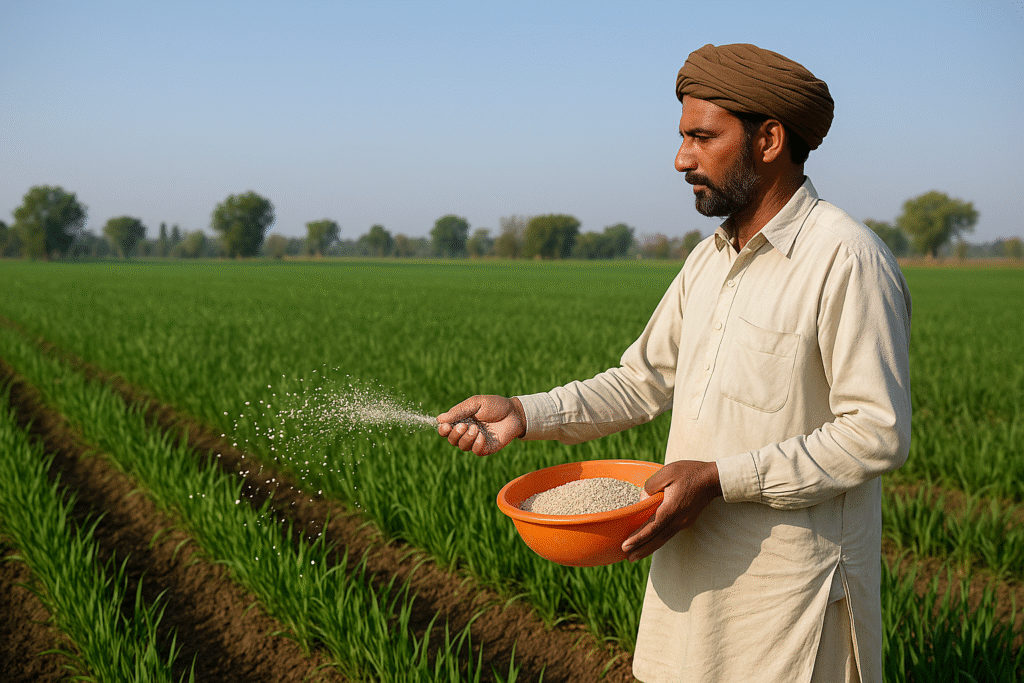
Role of DAP fertilizer in sustainable agriculture is increasingly important in modern farming, particularly in Pakistan. With rising demands on crop yield and soil preservation, Di-Ammonium Phosphate (DAP) provides essential nutrients while supporting long-term soil health. Its balanced nitrogen and phosphorus content makes it vital for both conventional and sustainable farming of Pakistan’s major crops.
Understanding the Role of DAP Fertilizer in Sustainable Agriculture
DAP fertilizer plays a dual role—supplying 18% nitrogen and 46% phosphorus (P₂O₅)—which are critical for root development, energy transfer, and vegetative growth. In sustainable agriculture, nutrient balance is essential, and DAP provides early-season vigor while minimizing nutrient losses when properly managed.
Composition and Efficiency of DAP Fertilizer
- Chemical formula: (NH₄)₂HPO₄
- Nutrient content:
- Nitrogen (Ammoniacal): 18%
- Phosphorus (P₂O₅): 46%
- Solubility: Fully water-soluble; fast-acting
- Application: Commonly used in basal fertilization across wheat, rice, maize, and cotton—major crops in Pakistan.
Sustainable Application Methods for DAP
Sustainable use of DAP involves techniques that maximize nutrient use efficiency and minimize environmental losses:
Band Placement Enhances the Role of DAP Fertilizer in Sustainable Agriculture
Placing DAP 5–10 cm below the seed ensures that phosphorus remains in the root zone and minimizes fixation in alkaline soils.
Combining DAP with Organic Inputs
When combined with FYM, compost, or green manure, DAP becomes more effective and less prone to leaching or binding with calcium in Pakistani alkaline soils.
Role of Biofertilizers in Enhancing DAP Performance
Phosphate Solubilizing Bacteria (PSB) such as Bacillus and Pseudomonas help unlock fixed phosphorus, improving the sustainable role of DAP fertilizer in agriculture.
Addressing Soil Challenges in Pakistan Using DAP
Most soils in Punjab, Sindh, and Balochistan are alkaline (pH > 7.5) and rich in calcium carbonate. These conditions lead to phosphorus fixation, where applied phosphate becomes unavailable to crops. This makes correct DAP application critical to sustainability.
Preventing Phosphorus Fixation
| Practice | Impact |
|---|---|
| Add organic matter | Chelates Ca²⁺ ions, prevents phosphate binding |
| Use acidifying fertilizers | Lowers soil pH near roots, improves P availability |
| Biofertilizer inoculation | Frees bound phosphorus through microbial activity |
Suppliers Supporting the Role of DAP Fertilizer in Sustainable Agriculture
Trusted DAP brands and suppliers in Pakistan help ensure quality input for sustainable agriculture:
- Engro Fertilizers – Zarkhez DAP
- Fauji Fertilizer Company (FFC) – Granular DAP
- Fatima Fertilizer – DAP and blended products
- Agritech Limited – Bulk imports for large farms
- ZTBL – Financing and subsidies for DAP purchases
Benefits of DAP in Sustainable Agriculture
| Benefit | Sustainable Impact |
|---|---|
| Early root growth | Reduces need for over-fertilization |
| Efficient nutrient absorption | Minimizes runoff and leaching |
| Increased yield per unit input | Supports resource conservation |
| Compatibility with organic inputs | Improves long-term soil structure |
Challenges in Using DAP for Sustainable Agriculture
Despite its benefits, using DAP fertilizer sustainably comes with several challenges, particularly in the Pakistani context:
1. Phosphorus Fixation in Alkaline Soils
Most soils in Punjab and Sindh are alkaline (pH > 7.5), causing phosphorus to bind with calcium and become unavailable to plants within weeks of application.
2. Overapplication & Imbalance
Excessive or continuous use of DAP can lead to nutrient imbalances, particularly high P-to-K ratios, which may reduce micronutrient uptake and crop resilience.
3. Cost & Affordability
DAP prices are often volatile due to import dependency, making it less accessible for smallholder farmers without subsidy support.
4. Environmental Concerns
Overuse or improper placement of DAP may result in phosphate runoff, contributing to eutrophication of nearby water bodies and harming ecosystems.
5. Lack of Awareness on Sustainable Use
Many farmers are unaware of best management practices, such as band placement, biofertilizers, or integrated nutrient management (INM) to improve phosphorus use efficiency.
Conclusion: Maximizing the Role of DAP Fertilizer in Sustainable Agriculture
The role of DAP fertilizer in sustainable agriculture is undeniable—it remains a foundational input for improving crop yields, especially in phosphorus-deficient Pakistani soils. However, to ensure sustainability:
- Use DAP judiciously and scientifically
- Integrate it with organic matter and biofertilizers
- Educate farmers on proper timing, placement, and dose
- Support policies for affordability and access
By combining smart farming practices with scientific knowledge, Pakistan can maximize DAP’s benefits while minimizing its environmental and economic risks.